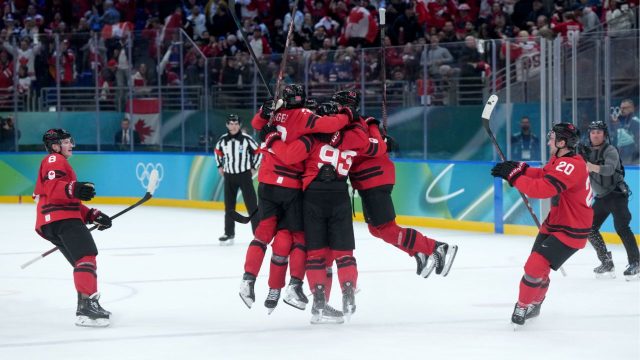
At the tail end of an all-time slate of hockey, a memorable stretch of Olympic quarterfinal tilts that saw three of four games turn into overtime nail-biters, the Americans capped off the chaos by bucking the day’s comeback trend.
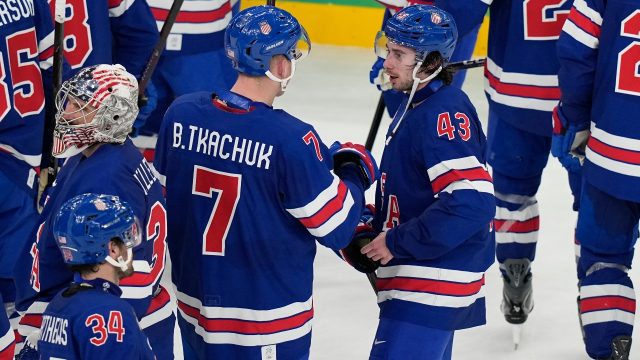
Fresh off watching Canada claw their way back against Czechia, and seeing Finland do the same against Switzerland, the U.S. was nearly on the wrong end of a third-straight script-flipping on Wednesday. After carrying a one-goal lead into the final moments of regulation during their quarterfinal matchup with Sweden, the U.S. saw Mika Zibanejad pot one late to knot things up with a minute-and-a-half to go. But unlike Czechia and Switzerland, the Americans managed to quell the comeback, defender Quinn Hughes wiring home the game-winner just a few minutes into the extra frame.
No. 43 was a fitting author for the Americans’ much-needed heroics. While it’s the Tkachuk brothers who’ve been in the spotlight as the U.S. has waded through the tournament to this point, the squad’s other pair of siblings has been just as vital to the team’s success — of the 18 goals the Americans have potted in the tournament so far, one or both of the Hughes brothers have played a part in half of those tallies.
Their fingerprints were all over Team USA’s tournament-opening win against Latvia, Quinn and Jack factoring in on four of the team’s five goals that night. Wednesday, it was another starring performance for the Hughes brothers, as they each registered an assist on the second-period tally from Dylan Larkin that gave the Americans the early lead, before Quinn collected the eventual game winner to send the U.S. on to the semis.
With six points through four games, Quinn ranks as the highest-scoring defender in the tournament to this point. It’s no doubt a welcome sight for an American squad that came into these Games haunted by the memory of their overtime loss to Canada in the 4 Nations Face-Off final — a game, and a tournament, they played without No. 43 in the lineup.
-
-
Keep up with Olympic men’s hockey
The men’s hockey tournament at Milano Cortina 2026 runs from Feb. 11-22. Follow along with all the scores and standings.

Questionable coaching decisions continue as Sweden bows out in quarterfinals
It’s been an odd tournament for Sweden. The star-studded Tre Kronor looked like a potential favourite coming into the Games, when the lineups were laid out on paper, but question marks about the squad’s coaching staff have rumbled on in the background throughout the tournament.
It started in Sweden’s first game, a win over Italy that seemed far too close for much of the night, when head coach Sam Hallam elected to bench veteran Filip Forsberg, an established high-end scorer at the NHL level and the fifth-highest scorer among all Swedes in the league this season. While other squads rotated in the extra players dressed for these international games, Hallam sent Forsberg out for just a single minute of ice time in that opening tilt — 13 minutes fewer than Tampa Bay Lightning third-liner Pontus Holmberg.
A couple games later, it was Jesper Bratt on the outside looking in. The New Jersey Devils standout — who’s amassed the second-most points of any Swedish NHLer across the past four seasons, behind only William Nylander — saw his ice time cut in Sweden’s second game, saw no ice in their third, and was ultimately sent to the press box for the squad’s qualification game vs. Latvia.
Wednesday, with Sweden’s Olympic dream on the line in the quarterfinals, Hallam put Bratt back in the lineup, but used him only sparingly — the winger played zero minutes in the first and second periods, but was sent out for shifts in the third, and in overtime.
Perhaps more questionable, though, was the deployment of another young talent on the Swedish roster Wednesday. Blue-line phenom Rasmus Dahlin — the highest-scoring Swedish defender in the NHL this season, and the third-highest scorer for Sweden at these Olympics — was stapled to the bench for the entirety of the extra frame, getting zero minutes in overtime. The 25-year-old looked visibly frustrated after the final buzzer went, slamming his stick on the bench.
It’s no doubt a frustrating end for the team as a whole, Sweden bowing out in the quarters after making it to the bronze-medal game in Beijing four years ago.
Finland pulls out overtime comeback of their own, outlasts Switzerland
A minute of chaos nearly sunk the defending gold medallists.
Late in the first period of their quarterfinal matchup with Switzerland, the Finns saw their Olympic dream seemingly go up in flames when they gave up a pair of goals in quick succession. It was the first of the two that truly put them on the back foot, veteran netminder Juuse Saros playing the puck right to an opposing forechecker behind the net and watching Switzerland pounce on the mistake. Not long after, the Swiss struck again, Nino Niederreiter walking in and wiring one past Saros from distance to give his countrymen a 2-0 lead.
For much of the tilt, that lead held, the Finns looking set to go down in humbling fashion. But an hour-and-a-half after Nick Suzuki and Mitch Marner pulled Canada out of the mud and into the semifinals, a few of Finland’s best came up with their own heroics. Sebastian Aho had kicked off the climb midway through the third, getting Finland on the board and cutting the lead to one. But it was Miro Heiskanen — in the final minutes of the period, with the Finnish net empty — who kept them alive, taking the puck off a great Roope Hintz dash and wiring it on net. It careened off Jonas Siegenthaler’s blade and past netminder Leonardo Genoni, tying the game with just over a minute left on the clock.
In the extra frame, it was a pair of Stanley Cup champs who combined to book Finland’s ticket to the semis, as Anton Lundell sprung Artturi Lehkonen for a chance in all alone on Genoni. The veteran winger made no mistake, going bar down to clinch it for the Finns.
It’s been an up-and-down tournament for Finland, the 2022 champs dropping their opening match against Slovakia before righting the ship and picking up some steam. After another shaky moment Wednesday, they’re on to the semifinals, perhaps buoyed by having to dig deep and pull this one out. But the next test will be much tougher: they’ll get Canada on Friday, the red-and-white having just pulled off the very same thing.
Slovakia send message with dominant, by-committee win over Germany
What a run it’s been for Slovakia. After a sterling showing at the 2022 Games in Beijing — in which the nation took down Germany, the U.S., and Sweden in do-or-die games, en route to a bronze-medal finish — the magic has continued in 2026.
There’s no question Juraj Slafkovsky has been at the centre of it. The Montreal Canadiens standout finished as the MVP and scoring leader of those 2022 games, and coming into Wednesday’s quarterfinal matchup with Germany, he’d managed three goals and six points through three games. But while the 21-year-old has been a star on the Olympic stage once again, his countrymen proved Wednesday that the rest of their squad can make plenty of noise, too.
Slovakia steamrolled Leon Draisaitl’s Germany 6-2 in their quarterfinal tilt. And they did it every which way. Pavol Regenda kicked things off with a deft tip off a point shot through traffic early. Then it was Milos Kelemen blowing by the German defence and roofing a slick backhander past Philipp Grubauer. Then Oliver Okuliar on a breakaway, and Dalibor Dvorsky off a 2-on-1. Regenda added another in the third, a quick shot through traffic, before Tomas Tatar iced it with a late empty netter.
They’ve booked their ticket to the semifinals, and they’ve sent a message, too. On a day that saw three of four Olympic quarterfinal tilts go down to the wire, requiring overtime to nail down a result, Slovakia bulldozed their way to the next round in convincing fashion. Next up: the Americans.